
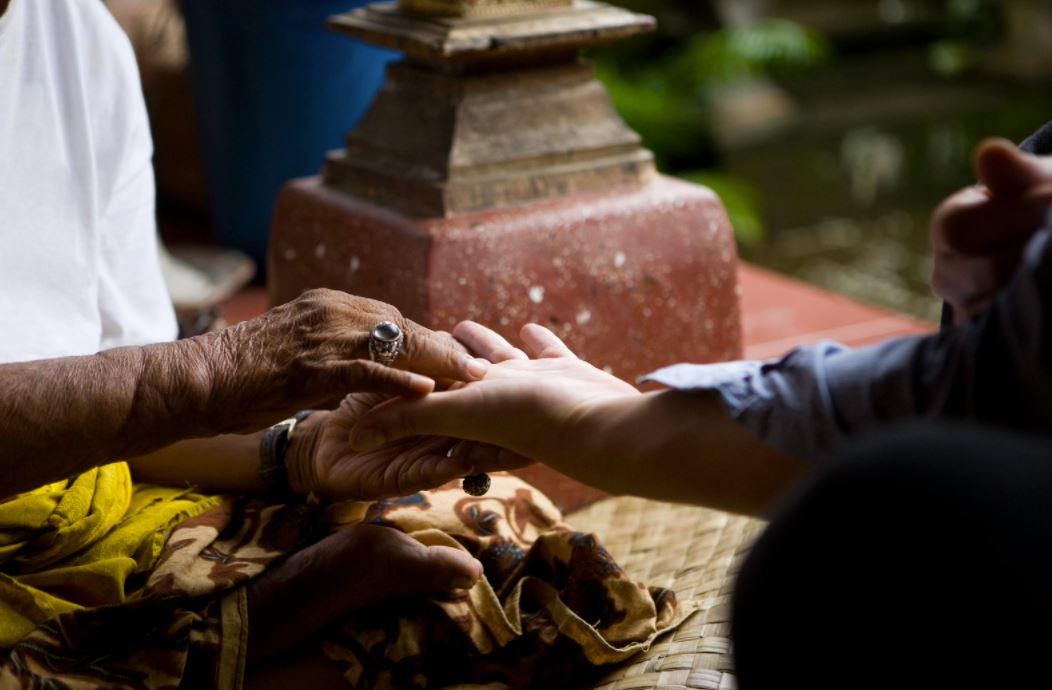
Your hands can reveal many ordinary facts: how you use them, where friction occurs, whether the skin is dry, and sometimes whether a change deserves medical attention. Palmistry adds a symbolic layer, interpreting lines, mounts, fingers, and hand shapes as themes about character or life direction. It can be an engaging reflective tradition, but it cannot reliably predict lifespan, children, wealth, illness, accidents, or a fixed future.
A responsible palm reading therefore sounds less like a verdict and more like a conversation. The reader describes what they observe, explains the traditional symbolism, invites the person to decide what resonates, and keeps medical, legal, financial, and psychological claims outside the reading.
Palmistry, Chiromancy, and the Physical Hand
Palmistry and chiromancy are commonly used for systems of divination or character interpretation based on the hand. Historical sources show that hand-reading traditions appeared in different places and periods, but sweeping claims that one single culture invented modern palmistry are difficult to prove. A historical Encyclopaedia Britannica entry on palmistry documents older European, Greek, Arabic, Chinese, and Indian references while also describing the system’s predictions as unverifiable.
Avoid the slur “gypsy” and the stereotype that fortune-telling defines Romani identity. Romani people are a diverse ethnic group, not a mystical character type or historical prop. A reader can discuss the practice without assigning it to an entire people or dressing cultural caricature as tradition.
Physically, the prominent lines on a palm are flexion creases that form before birth and help the skin fold as the hand moves. Their presence is anatomy, not proof of destiny. MedlinePlus explains palmar creases and notes that a single transverse crease is often a normal variation. When clinicians consider a crease medically, they do so alongside history, examination, and other findings—not through palmistry.
What the Traditional Lines Symbolize
Systems vary, so there is no universal dictionary. In many popular Western methods:
- The heart line is used to discuss emotional expression, intimacy, and values in relationships.
- The head line is used to discuss thinking style, attention, imagination, and decision-making.
- The life line is used to discuss vitality, transitions, support, and a person’s relationship with stability—not the date of death.
- The fate or career line is used to discuss work, obligation, direction, and turning points. Not everyone has a prominent one.
- Bracelet or rascette lines at the wrist may carry symbolic meanings in some systems, but their number does not measure years of life.
For a line-by-line orientation, the site’s palmistry basics for beginners owns the practical map of hands, mounts, and major creases. This page focuses on what can responsibly be inferred, how to structure a reading, and how to avoid harmful predictions.
A Palm Cannot Predict Lifespan or Death
No palm line can establish the age or manner of a person’s death. Stories about a reader foretelling a fatal accident are anecdotes, not verifiable evidence. They are also harmful teaching tools: a frightening prediction can linger for years, shape behavior, and make ordinary events feel like confirmation.
Never tell someone that a short, broken, faint, or changing life line means an early death, disease, miscarriage, or catastrophe. Never use bracelet lines to calculate lifespan. If a person asks “How long will I live?”, redirect toward what is actionable now: preventive care, safety, relationships, financial planning, and how they want to use their time.
A Palm Cannot Count Children or Guarantee Relationships
Fine lines below the little finger are sometimes labeled relationship or child lines, but they cannot determine fertility, pregnancy, the number or sex of children, adoption, marriage, divorce, or a partner’s faithfulness. These claims can be especially painful for people facing infertility, pregnancy loss, family estrangement, or an unsafe relationship.
Use consent before discussing family. Ask, “Would you like to explore what care, commitment, or family means to you?” Accept no without pressure. Do not infer sexual orientation, gender identity, pregnancy, disability, trauma, or relationship status from a hand.
How to Give a Reflective Palm Reading
- Set expectations. Say that palmistry is a symbolic practice for reflection and entertainment, not a validated diagnostic or predictive method.
- Ask permission. Confirm whether touch is welcome and which topics are off-limits. Let the person hold and turn their own hand.
- Describe before interpreting. Note visible features neutrally: “This crease is curved and clear,” rather than “You are emotionally damaged.”
- Offer symbolism tentatively. Use phrases such as “Traditionally, some readers associate this with…” and “One question this might raise is…”
- Invite the person’s meaning. Ask an open question rather than fishing for private facts or forcing agreement.
- Separate facts from themes. Do not turn a symbolic interpretation into claims about health, money, crime, pregnancy, or another person’s thoughts.
- Close with choice. Summarize one value or practical next step the person selected. Avoid certainty and dependency.
Photographing a hand requires separate consent and a clear explanation of storage and use. Do not post, retain, or train a system on someone’s image without permission. Wash hands or use another appropriate hygiene method between clients, and never touch broken skin.
Use Questions Instead of Predictions
A symbolic reading is most useful when it creates thoughtful questions:
- What helps you feel emotionally safe enough to be honest?
- Which decision needs more evidence rather than more urgency?
- Where are you using your strengths, and where are you overextended?
- What part of work feels chosen, and what part feels imposed?
- Which relationship boundary would protect mutual respect?
- What small action would make this interpretation useful this week?
These prompts do not require the palm to reveal hidden facts. They use a visual symbol to help the person articulate their own experience.
When Hand Changes Need Medical Attention
A palmist should not diagnose illness from lines, color, temperature, tremor, swelling, nails, or skin. Some visible changes are harmless; others deserve qualified assessment. Refer rather than interpret when there is a new or changing dark nail streak, a wound that is not healing, marked swelling, severe pain, signs of infection, sudden weakness or numbness, or a major change after injury.
The American Academy of Dermatology’s nail-change guidance explains that changes in color, texture, or shape can be harmless or can signal disease, and identifies changes a dermatologist should examine. A psychic interpretation must never delay medical care or advise someone to stop prescribed treatment.
Money, Fear, and Ethical Boundaries
A reading should have a clear price, time limit, and scope. Do not claim that a palm shows a curse, inherited darkness, imminent disaster, blocked wealth, or danger to a loved one. Never sell repeated sessions, rituals, candles, crystals, or transfers as the only way to prevent harm or “correct” a line.
Stop if a reader demands secrecy, isolates you from trusted people, guarantees prosperity, pressures you to pay immediately, or asks for gift cards, cryptocurrency, a wire, or access to financial accounts. The Federal Trade Commission’s guide on how to avoid scams identifies urgency and hard-to-reverse payment methods as common warning signs. If you paid, contact the payment company promptly, preserve records, and report the fraud.
The same limits apply beyond palmistry. Before booking any intuitive service, use this guide to evaluate psychic messages and reader boundaries, then make consequential decisions from independent evidence and qualified advice.
Can Palm Lines Change?
Hands change through growth, aging, movement, work, injury, dryness, swelling, scarring, and skin conditions. Fine surface lines may look different with lighting, camera angle, moisture, or how the hand is held. That does not prove that destiny has changed.
If you want to compare hands over time, take photographs under the same light, angle, distance, and hand position. Treat changes as observations. A sudden physical change should be assessed on medical grounds when appropriate, not explained as a spiritual upgrade or warning.
A Useful Standard for Palmistry
A good reading leaves a person with more agency, not less. It respects culture, privacy, consent, uncertainty, and professional boundaries. It does not frighten, diagnose, promise, or create dependence. The “knowledge” in your hands is not a secret timetable of fate; it is an invitation to notice how you live, what you value, and what choice you want to make next.
Frequently Asked Questions
Can a life line predict how long I will live?
No. The length, depth, or breaks in a palm crease cannot determine lifespan or cause of death. Treat life-line meanings as symbolic themes only and use qualified medical and safety guidance for real health decisions.
Can palmistry tell how many children I will have?
No. Fine lines near the little finger cannot establish fertility, pregnancy, adoption, or the number or sex of children. A responsible reader does not make reproductive predictions.
Is palmistry scientific?
Palmistry is a cultural and divinatory practice, not a validated method for predicting events, diagnosing health, or measuring personality. Physical palm creases are anatomical features; any spiritual interpretation should be presented as optional symbolism.
What makes a palm reading ethical?
An ethical reading uses informed consent, tentative language, privacy, a clear price, and firm limits on health, legal, financial, pregnancy, death, and third-party claims. It supports the person’s choices and never uses fear to sell more services.